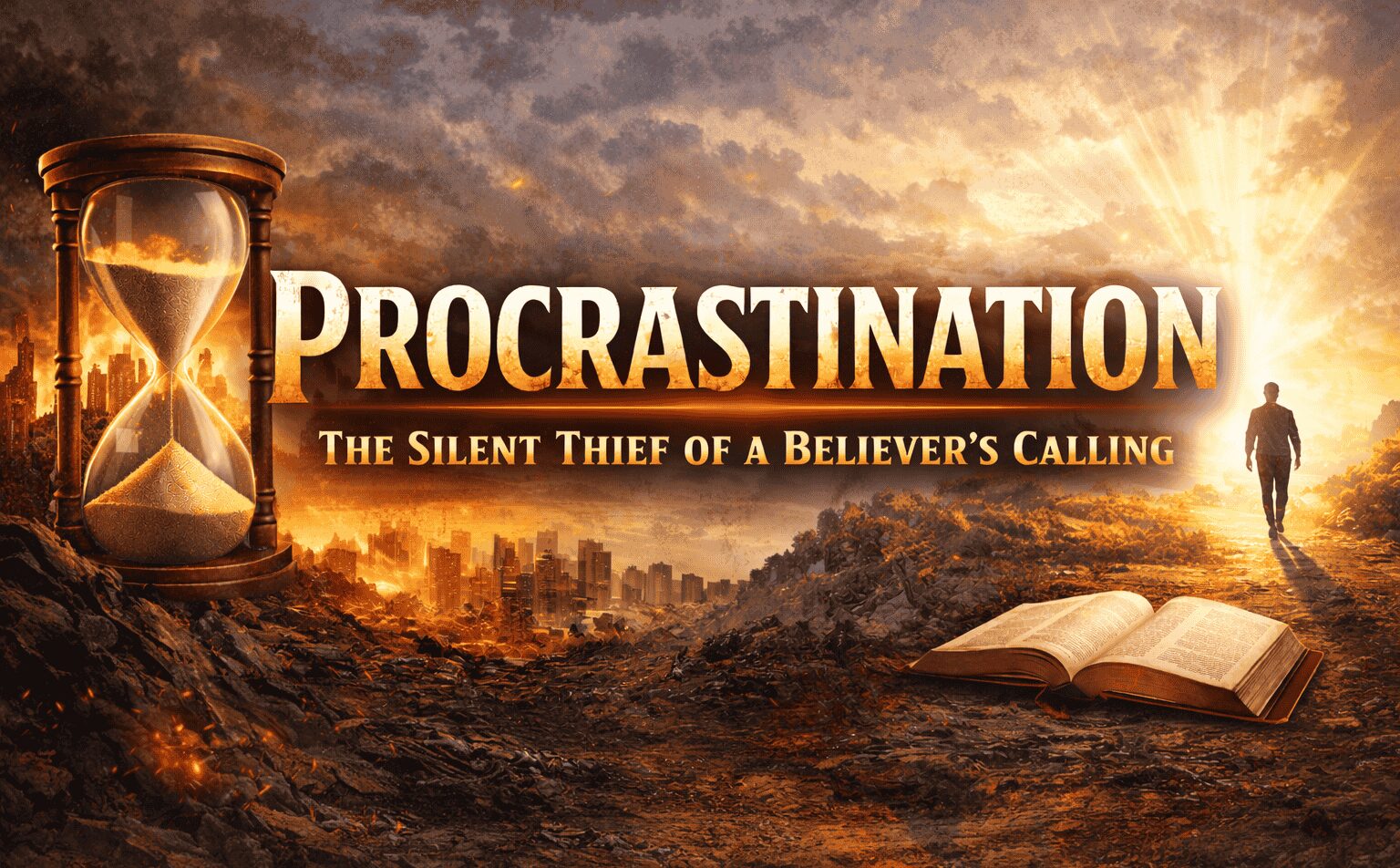
The greatest danger to a believer’s success is the spirit of procrastination. According to the Oxford Dictionary, procrastination is the act of delaying or postponing something. Every day, we encounter people who speak passionately about the great plans they have for their lives. Some talk about a calling they once sensed from God. Others describe directions they believed they were meant to pursue. Yet as time passed, excuses replaced obedience, opportunities slipped away, and ultimately many surrendered their dream or calling—not to failure, but to procrastination.
As believers, we are created in the image and likeness of God. Each of us has been given grace gifts for useful service in His Kingdom. There are divinely appointed goals and directions that we are meant to pursue. Prayer is essential to gaining clarity for each assignment, because every calling is connected to the advancement of the Kingdom of God. From the foundations of the world, God established a plan for every individual and for all mankind. These plans were set in motion when God commanded humanity to go forth, be fruitful, multiply, fill the earth, and subdue it.
A calling has already been activated, but to see it fulfilled we must engage it with all the strength God has given us. There is no lack in God. To everyone who asks for what is required to accomplish His will, God has promised provision. Jesus said in John 14:13–14, “And whatever you ask in My name, that I will do, that the Father may be glorified in the Son. If you ask anything in My name, I will do it.”
Scripture clearly reveals the danger of delayed obedience. In Genesis 19:15–16, we read the account of Lot, his wife, and his daughters. As judgment approached Sodom, the angels urged Lot to flee. Yet he lingered. Because of God’s mercy, the angels physically seized their hands and led them out of the city. Lot nearly lost everything because he procrastinated. His wife lost her life because she chose comfort over God’s warning and urgency. She decided to look back. They escaped, but barely.
Procrastination almost cost them everything. This raises an important question: What do our delays cost us—and how do they shape our future?
Before answering that, we must understand what we possess and what we are responsible for.
First, each of us has been created with purpose. God works through people—redeemed, called, adopted vessels—through whom He reveals His love and victory purchased at Calvary.
Second, our bodies are the temple of the Holy Spirit (1 Corinthians 6:19–20). God accomplishes His purposes through us, not apart from us.
Third, the Church—of which we are a part—exists to reveal God’s wisdom and power. Ephesians 3:9–10 tells us that through the Church, the manifold wisdom of God is made known even to heavenly powers. We are the visible testimony of His triumph.
Fourth, we have access to everything we need. 2nd Peter 1:3–4 declares that God’s divine power has given us all things that pertain to life and godliness. There is no lack for the believer—only unused provision.
God is no respecter of persons. We have all been adopted by His grace (Ephesians 1:5–6), created for good works prepared in advance (Ephesians 2:10), given a measure of faith (Romans 12:3), and empowered with grace gifts and spiritual gifts to function fully in His purpose (Romans 12; 1 Corinthians 12).
What we must understand is this: there is a set time for obedience. Jesus warned in Matthew 24 that readiness matters because we do not know the hour of His return. The unfaithful servant assumed delay, became careless, and lost everything. Procrastination cost him his future.
Many opportunities are missed because of delay. Many dreams die not from opposition, but from neglect. When we procrastinate in prayer, answers never arrive because they are never pursued. James 4:2 reminds us, “You do not have because you do not ask.” Procrastination always results in loss.
To remain on course and finish the race, we must guard against four areas where procrastination gains a foothold.
Area 1: Loss of Fire
Revelation 3:14–16 describes the lukewarm church of Laodicea. Their lack of passion offended Christ. Without fire, there is no urgency, no vision, and no movement. Proverbs 29:18 tells us that without vision, people cast off restraint. Where fire dies, procrastination thrives.
Area 2: Lack of Discipline
Paul writes in 1 Corinthians 9:24–27 that discipline is essential to finishing well. The flesh resists obedience and seeks comfort. If left unchecked, it will slow us down and divert our course. Emotions, offense, weariness, and hardship must be confronted, not indulged. A disciplined life is a productive life. Prayer, the Word, family, service, and stewardship all require intentional order. Without discipline, even the called can become disqualified.
Area 3: Distractions
Jesus warned in Matthew 13:22 that the cares of this world and the deceitfulness of riches choke the Word and render believers unfruitful. Many distractions are avoidable, yet we allow them to dominate our time and attention.
Paul warned Timothy that the desire for excess leads to traps and destruction (1 Timothy 6:8–9). He also reminded us that a soldier does not entangle himself in civilian affairs if he wants to please his commander (2 Timothy 2:4–5). Focus is essential to fulfilling the call.
Area 4: Laziness
Laziness destroys vision faster than opposition. Proverbs paints a vivid picture of neglect, decay, and loss in the life of the sluggard (Proverbs 24:26). Unless he gets a God encounter, he will never change his ways. Laziness always has an excuse and resists correction. Proverbs 19:15 warns that laziness leads to poverty and hunger.
Believers are called to exploits. Jesus commanded us to go, preach, and make disciples. But if we cannot rise from complacency, the work remains undone—and accountability remains unavoidable. Second Corinthians 5:9–10 reminds us that we will all give an account for what we did with what we were given.
Knowing this, Romans 13:12–14 calls us to wake up, cast off darkness, and put on Christ. Let us reclaim the zeal that consumed Jesus for His Father’s house (John 2:17).
As we do, fire will be restored, discipline strengthened, and focus renewed. Distractions and laziness will lose their grip. Procrastination will be a word of the past. And we will move forward—boldly and faithfully—into the perfect will and timing of God.
Call to Action:
- Pause and examine your heart. Ask the Lord where delay has replaced obedience, and invite Him to restore clarity, courage, and resolve.
- Consider what you may be postponing. Bring that calling, decision, or assignment before God, and ask for grace to act in His timing rather than your comfort.
- Take time today to listen. Reflect on what God has already spoken, and commit to responding with faith instead of waiting for a more convenient moment.